GraphMind
PROTOTYPEAn AI-powered knowledge system that transforms unstructured documents into connected, queryable knowledge.
Overview
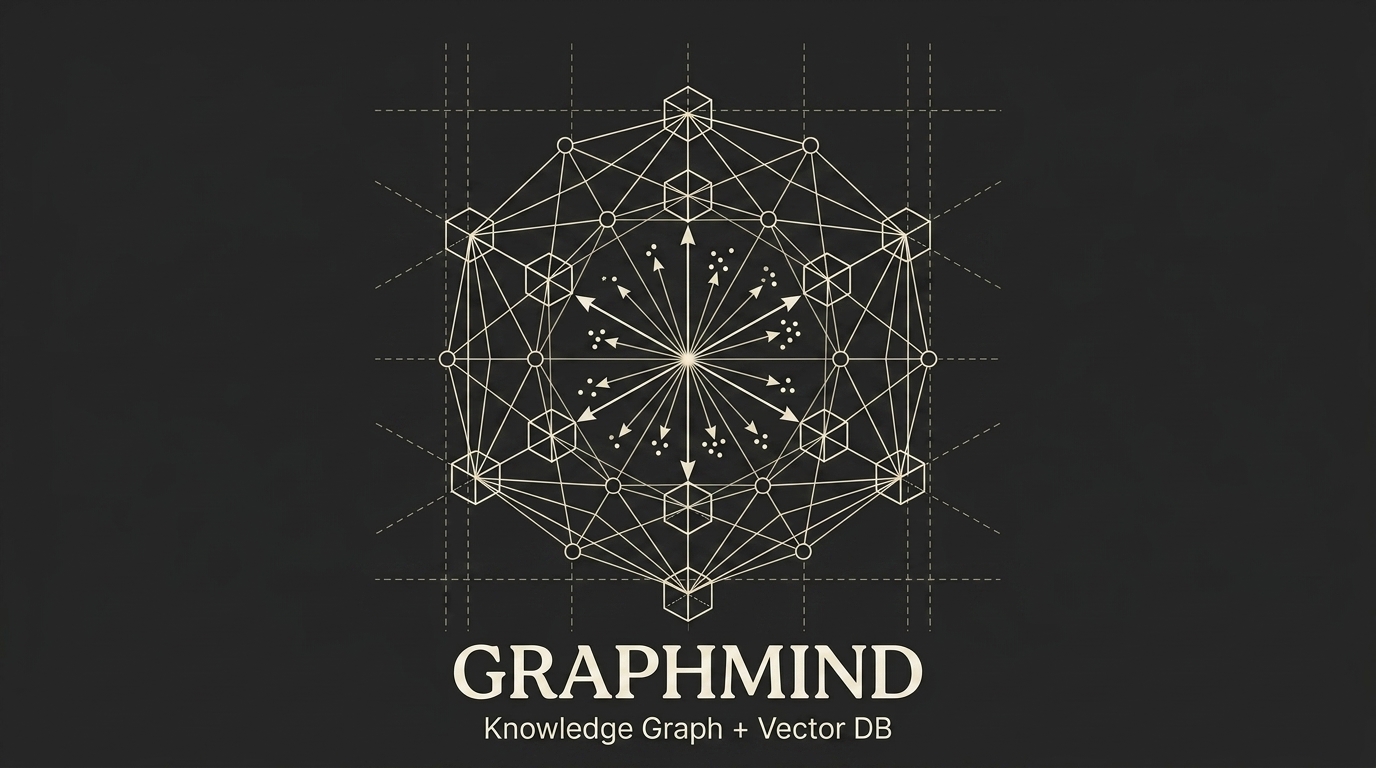
GraphMind bridges the gap between raw text and structured intelligence. Rather than relying purely on vector similarity, it extracts entities and relationships to construct a queryable knowledge graph. By combining vector search with graph traversal (Hybrid Retrieval), it provides evidence-backed reasoning that is highly resistant to hallucinations.
Architecture
Why I built this
Standard RAG (Retrieval-Augmented Generation) fails on complex reasoning tasks because it lacks understanding of global relationships between concepts. I conceptualized GraphMind to solve the 'multi-hop' reasoning problem by explicitly defining relationships in a graph database.
Engineering Challenges
- Accurately extracting strict semantic triplets (Subject-Predicate-Object) from messy text
- Balancing latency between Neo4j graph traversal and PostgreSQL vector search
- Evaluating the accuracy of AI-generated answers against the original source documents
What I learned
Hybrid retrieval (Graph + Vector) dramatically outperforms pure vector search when answering questions that require synthesizing information across multiple documents.
Stack
 Next.jsFastAPIPython
 PostgreSQLpgvectorNeo4j
 Redis
Redis Docker